
Troubleshooting
How to Choose a Truly Durable Metal Baler
In the metal recycling industry, a metal baler is the heart of logistics efficiency. However, as an engineer who has spent over a decade on the shop floor, I see a recurring and painful reality: many buyers focus solely on "tonnage" and "price." The result? Equipment returns to the yard only to suffer from leaking cylinders, box deformation, and bales that don't meet density standards within six months.
Today, let’s skip the "industry-leading" marketing buzzwords. We are going to deconstruct the design logic of a baler to see what a high-efficiency, durable metal baling machine actually looks like.
1. The Working Principle: It’s More Than Just "Squashing" Metal
The core task of a metal baler is to use hydraulic power to compress loose metal scrap—such as aluminum profiles, steel offcuts, or copper wire—into high-density rectangular, cylindrical, or octagonal blocks.
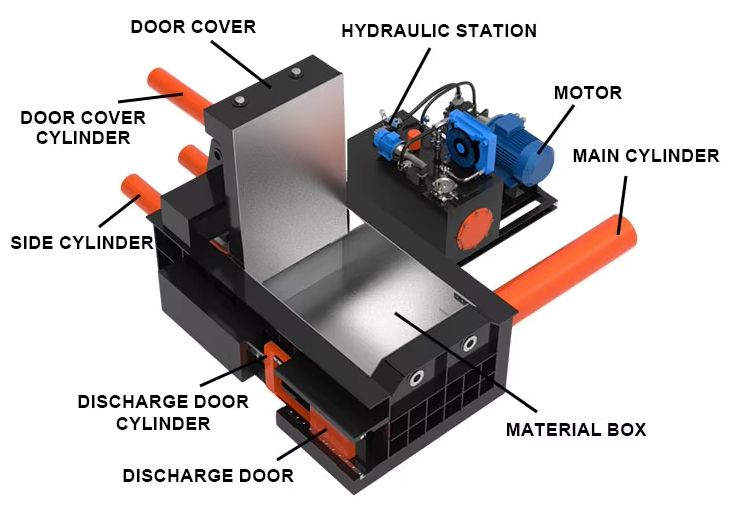
Structurally, the two mainstream designs are Side-Push (Horizontal)and Lid-type (Triple Compression).
Engineer’s Logic: If you are processing thinner aluminum profiles or light loose materials, a Lid-type baler is more flexible for loading. However, if you are dealing with tougher, heavy-duty steel scrap, the Side-Push structure offers superior box rigidity. This design better absorbs the massive counter-forces, preventing fatigue cracks in the main frame over time.
2. Material Applicability: Don't Expect One Machine to "Do It All"
As an engineer, I must be honest with you: no baler is perfect for every material.
Aluminum and Copper: These materials have high "elasticity." When baling, you need specific hydraulic dwell time, or the bale will "spring back" or burst once ejected.
Steel Offcuts:These are brutal on the box liners. High-hardness liners are non-negotiable here.
What NOT to Bale: Please remember, a standard metal baler is not designed for heavy structural steel (e.g., steel plates over 20mm thick). Forcing this will lead to a bent piston rod in the main cylinder. For these materials, you should be looking at a Gantry Shear, not a baler.


3. Core Components: Three Areas That Define Machine Lifespan
Hydraulic Cylinders
The source of power. We insist on using forged steel cylinders rather than cast pieces. Why? Under high pressure, cast parts often have microscopic "sand holes" (porosity), which are ticking time bombs for oil leaks. Forged parts handle the stress cycles of a high-production yard far better.
Wear-Resistant Liners
The inside of a baler box is a "battlefield." We recommend NM500 grade wear-resistant plates. Many manufacturers use cheaper manganese steel to save costs. You won't see the difference on the day of delivery, but after three months of processing steel scrap, those cheap liners will be worn thin as paper, leading to permanent deformation of the main structure.
Hydraulic Valves and Cooling Systems
Why do we emphasize cooling? In regions like the Middle East or Southeast Asia, if hydraulic oil temperature stays above 60°C (140°F) for long periods, your seals will fail rapidly. In high-temperature environments, an industrial oil cooler (air or water-cooled) is not an "option"—it is a necessity for survival.
4. Technical Features: Solving Real-World "Headaches"
In our design process, we optimize small details that solve big problems for operators:
Anti-Jamming Cutting Blades:We integrate cutting blades along the edges of the lid and the side walls. If scrap hangs over the edge during the closing cycle, the lid shears it off cleanly. This prevents material from jamming the gate and triggering a pump overload alarm.
Differential High-Speed Circuit:By using differential logic in the hydraulic circuit, we increase the "no-load" stroke speed by up to 30%. In practical terms, this allows you to produce 8 to 10 more bales per shift compared to standard circuits.
5. Case Study: Why Do Similar Tonnages Produce Different Results?
Last year, we customized a 250-ton metal baler for a client in the UAE. The client had previously used a budget machine and found their bales were too loose, resulting in poor container loading efficiency.
Upon analysis, we found their original machine had insufficient pump displacement and lacked secondary compression logic. After switching to our equipment—which optimized the compression chamber's aspect ratio—the bale density increased by 20%. For B2B exporters, this meant fitting 4 more tons into every shipping container. In the world of scrap, density is profit.
6. Maintenance: Three Tips from a Field Engineer
Oil Filtration:80% of hydraulic pump failures are caused by contaminated oil. You must change the hydraulic oil and clean the filters after the first 200 hours of operation.
Check Blade Clearance:If the gap between the shearing blades exceeds 3mm, small "burrs" of metal will wedge into the gaps. Over time, this buildup acts like a wedge, slowly warping the entire box.
Bolt Tightening: Hydraulic systems create vibration. A weekly check of the cylinder mounting bolts is the simplest way to prevent a catastrophic breakdown.
Get Your Metal Recycling Solution
Every yard has different materials and throughput requirements. If you are struggling to choose the right baler or if your current equipment is constantly breaking down, contact our engineering team. We don’t just send a catalog; we provide a technical proposal based on your specific scrap type and daily production goals.Contact our engineers for a custom proposal.
Leave a Message