
Industry Insights
Tyre Recycling Process
A Complete Step-by-Step Guide
Scrap tyres, often referred to as "Black Pollution," represent one of the most challenging waste streams due to their durability and complex composition of rubber, steel, and fiber.A professional scrap tire recycling line is the only way to turn this burden into profit. However, for a recycling plant owner, a scrap tyre is a reservoir of high-value raw materials.
As a recycling equipment engineer, I see many investors focus only on the final output—be it rubber granules or fuel—while overlooking the mechanical logic required to get there. This guide breaks down the professional Tyre Recycling Production Line from an engineering perspective, focusing on efficiency, heat control, and component longevity.
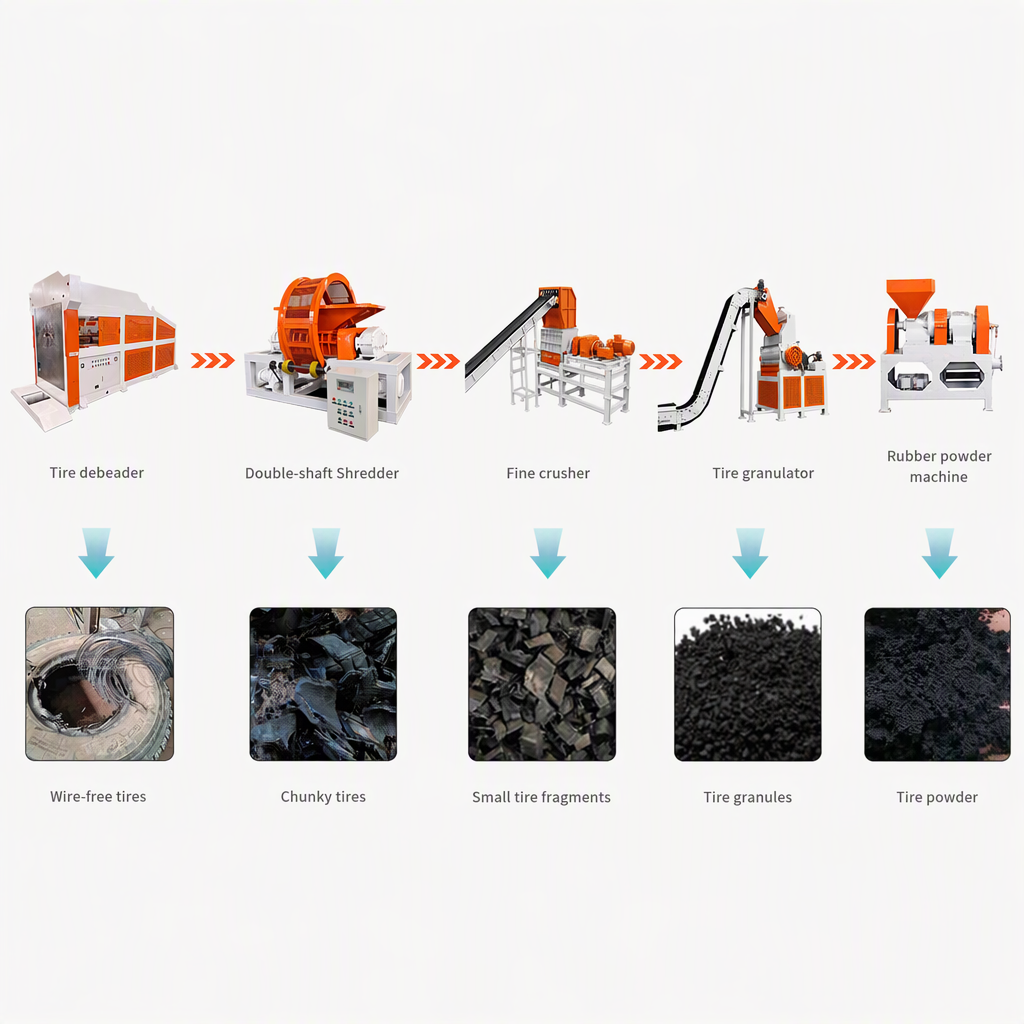
1. Step One: Steel Wire Debeading
Before a tyre ever touches a shredder, the thick bead wire (the high-tensile steel ring that holds the tyre to the rim) should be removed.
Engineer’s Logic: While heavy-duty shredders can cut through bead wires, doing so drastically accelerates blade wear and increases electricity consumption. A dedicated Wire Drawing Machine pulls the wire out cleanly, extending the life of your shredding blades by up to 40%.
2. Step Two: Primary Shredding (Double Shaft Shredder)
Once the bead is removed, the tyre enters a Double Shaft Shredder. This machine operates at low speed and high torque, using massive alloy steel blades to shear the tyre into 50mm-100mm rubber chips.These chips can be sold directly as TDF (Tyre Derived Fuel) for cement kilns or paper mills.
Expert Insight: Do not expect a uniform size at this stage. The goal here is "Volume Reduction." The low-speed design is critical to prevent the rubber from heating up and sticking to the blades, which is a common failure point in poorly designed lines.
3. Step Three: Secondary Grinding (Steel Wire Separation)
The rubber chips are then fed into a Steel Wire Separator (Rasper). This machine grinds the rubber further, reducing it to 10mm-20mm pieces. Simultaneously, the impact and friction loosen the connection between the rubber and the internal steel wires.
A high-strength magnetic drum is used at the discharge port to extract 99% of the steel wire. This wire is high-quality scrap steel and serves as a secondary revenue stream.
4. Step Four: Granulation and Fiber Separation
The steel-free rubber enters a granulator, which shears it into 1mm-6mm granules(also known as rubber crumbs). At this stage, the fiber (nylon/polyester) is separated.
Technical Challenge: Fiber is light and difficult to catch. We use a combination of Vibratory Screens and Centrifugal Air Separators to pull the fiber fluff away. If your fiber separation isn't clean, the market value of your rubber granules will drop significantly, as they cannot be used for high-quality sports tracks or molded products.
5. Step Five: Fine Powder Production (Optional)
If your market requires 40-100 mesh rubber powder, a Rubber Grinder is added. This stage uses a water-cooling system to keep the rubber temperature below 50°C. If the rubber burns during grinding, it loses its chemical activity (vulcanization properties), making it useless for new tyre production or asphalt modifiers.
Technical Maintenance: The Engineer's Checklist
To keep a tire recycling line running efficiently, you must focus on Heat and Sharpness:
1.Blade Sharpening:
Dull blades don't cut; they tear. This increases the load on the motor and generates heat.
2. Magnetic Protection:
Ensure no large metal chunks (like rim pieces) enter the granulator, or you will face days of downtime.
3.Cooling Systems:
Always check the water flow in your grinding stage. Heat is the enemy of rubber quality.
Optimize Your Tyre Recycling ROI
The difference between a profitable plant and a struggling one lies in the precision of the separation process. If you are looking for a technical proposal that balances durability with energy efficiency, contact our engineering team. We provide custom layouts designed to handle your specific tire sizes and target output.Investing in a fully automatic tire recycling system ensures lower labor costs.
Online message